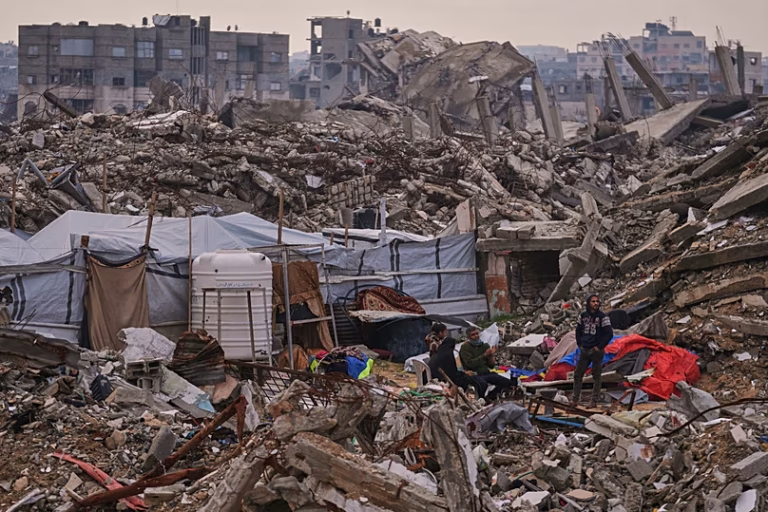
An aerial image, published by the Israeli army, of Jabalia in northern Gaza after more than two months of the largest genocide campaign it launched on the strip
EDITORIAL
Two years after October 7, the ruins of Gaza are not just the remnants of a war. They are the bones of a moral order that has collapsed — a monument to the world’s indifference and hypocrisy. What began as Israel’s “war on terror” has long since become a war on existence itself, a systematic campaign of annihilation against a besieged population that was already starving before the bombs began to fall.
In Gaza today, there are no schools left to reopen, no hospitals left to heal, and no homes left to return to. The people who survive do so by eating leaves, by drinking contaminated water, by burying their children in the rubble of what was once their city. The Israeli government calls this self-defence. Western leaders call it Israel’s “right to protect itself.” But what is being protected when a million children are deprived of food, medicine, and shelter? What security is achieved by turning an entire people into refugees within a cage?
Genocide in Real Time
For decades, the world said “never again.” Yet the evidence is there for anyone willing to see: the deliberate destruction of civilian infrastructure, the targeting of medical facilities, the cutting off of food and fuel supplies, and the dehumanizing language from Israeli officials who describe Palestinians as “human animals.” These are not the unfortunate side-effects of war; they are its method. The logic is genocidal — erase the people by erasing the conditions of their life.
International law was written precisely for moments like this, but law without courage is nothing. The International Court of Justice’s cautious warnings and half-hearted condemnations have not stopped the flow of Western weapons. The United States, Britain, and Germany — all self-proclaimed defenders of human rights — continue to arm and fund a campaign they cannot legally justify and morally cannot defend. Their leaders condemn Hamas for war crimes, as they should, but then proceed to enable crimes of far greater scale and permanence.
The Arab World’s Shame
Equally damning is the complicity of Arab regimes that have traded solidarity for stability. Egypt seals the Rafah border; Saudi Arabia toys with normalization; the Emirates count their trade profits. Their silence is not neutrality — it is participation. Arab leaders fear that a free Palestine would inspire their own citizens to demand freedom. Better, then, to keep Gaza as an open wound: a symbol of resistance that never quite heals, managed carefully so that it never spreads.
Meanwhile, the Arab street — from Amman to Rabat, from Cairo to Tunis — continues to march. Ordinary people raise the Palestinian flag not out of nostalgia, but out of recognition: Gaza’s oppression is their own future, if tyranny and dependency remain the region’s currency. The moral contrast between rulers and ruled has never been starker.
The Western Mirror
For the West, Gaza has shattered the illusion of moral superiority. The same governments that cry for Ukraine’s sovereignty cheer while an occupation pulverizes a stateless people. The same journalists who count every Russian bomb in Mariupol look away when a thousand-pound bomb falls on a UN shelter in Khan Younis. Western media, trapped between fear of antisemitism accusations and allegiance to power, have abandoned their duty to truth. They speak of “clashes” and “conflicts” as if there were two armies fighting on equal ground — not one of the most powerful militaries on earth bombing a trapped civilian population.
But something else is happening too: people are breaking the spell. Across Europe and the United States, mass protests have forced the word “genocide” into the public lexicon. Students occupy universities; artists boycott festivals; trade unions refuse to handle weapons shipments. Civil society, more than any government, has become the conscience of the West. The same streets that once marched against apartheid now chant for Gaza. History, it seems, remembers the side of the oppressed even when politicians do not.
The Price of Silence
Silence, however, has a price. Each government that chooses complicity over conscience erodes its own credibility. Each Arab state that turns away from Gaza confirms to its people that its legitimacy rests not on justice but on repression. Each journalist who avoids the word “genocide” for fear of controversy contributes to the normalization of mass killing.
When this horror finally ends — and it will, as all colonial wars eventually do — the world will ask who spoke and who stayed silent. The documents will show the names of the victims, the serial numbers of the bombs, the companies that sold them, and the politicians who smiled and shook hands while children starved. The moral reckoning will come too late for Gaza’s dead, but not too late for the living to learn.
A Test of Civilization
The Palestinian tragedy is also a test of civilization itself — of whether the words “human rights,” “international law,” and “the rules-based order” still mean anything. If they do, then the genocide in Gaza must end not with vague resolutions or ceasefire “pauses,” but with justice: arms embargoes, trials for war crimes, reparations, and liberation. Anything less is complicity disguised as diplomacy.
If the West continues to arm and defend Israel’s war of extermination, it will have written its own obituary as a moral actor. The Arab regimes that suppress protest will discover that fear cannot erase memory. And Israel — which could have chosen peace, coexistence, and equality — will find that it has destroyed not only Gaza but also its own claim to humanity.
For now, Gaza remains the mirror in which the world sees its true face. What we do — or fail to do — in this moment will define us far longer than any war.
©TNPP
Discover more from The New Palestine Post
Subscribe to get the latest posts sent to your email.