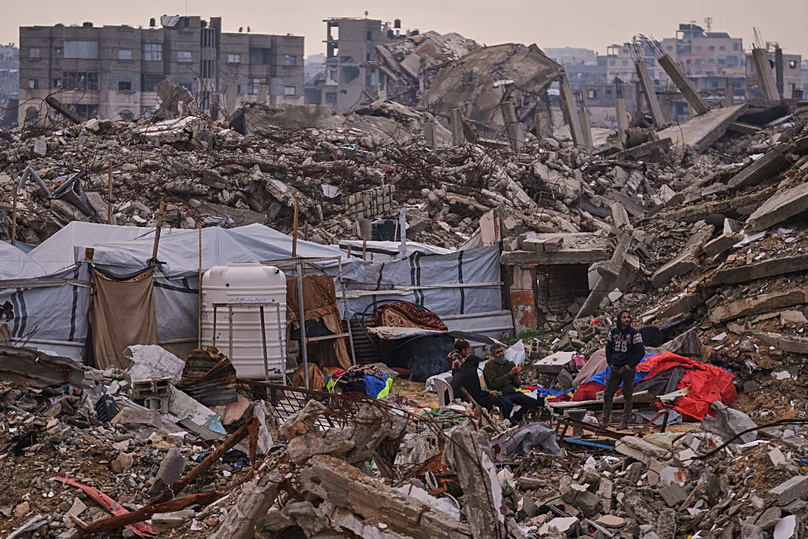
Unexploded bombs scattered across the Gaza Strip will pose a deadly obstacle to reconstruction efforts for decades, according to United Nations officials, who say the scale of contamination risks prolonging humanitarian suffering long after the fighting subsides.
Speaking at a briefing in Geneva, the United Nations Mine Action Service (UNMAS) said clearing explosive remnants of war in Gaza could cost more than $540 million, underscoring the magnitude of the challenge facing any post-war recovery plan.
The agency warned that unexploded ordnance—ranging from aerial bombs to improvised explosive devices—continues to endanger civilians and humanitarian workers while severely delaying rebuilding efforts. According to UN estimates, explosive remnants are found roughly every 600 metres across the enclave, highlighting the density of contamination.
Officials stressed that the threat is not only immediate but long-term. Aid groups and demining experts say that even partial clearance could take decades, with some projections suggesting between 20 and 30 years just to make the surface relatively safe.
The presence of unexploded bombs has already resulted in significant casualties. UN data indicates that more than a thousand people—many of them children—have been killed by such remnants since the conflict escalated, illustrating the ongoing risks posed by munitions left behind in densely populated areas.
The contamination adds a critical layer of complexity to Gaza’s broader reconstruction challenge. A joint assessment by the United Nations, European Union and World Bank estimates that more than $71 billion will be required over the next decade to rebuild the territory’s devastated infrastructure, including homes, hospitals and schools.
However, experts warn that reconstruction cannot proceed at scale until large areas are cleared of explosives. Rubble removal, infrastructure repair and the return of displaced populations all depend on securing land that is currently unsafe.
Humanitarian organisations have described Gaza as an “unmapped minefield,” with explosives buried beneath millions of tonnes of debris. The combination of widespread destruction and hidden ordnance means that even after a ceasefire, the dangers will persist for generations.
UN officials emphasised that without sustained funding, access for demining teams and long-term political stability, efforts to neutralise the threat could stall—leaving Gaza’s recovery not only delayed, but fundamentally constrained by the legacy of war.
Source: UN
Discover more from The New Palestine Post
Subscribe to get the latest posts sent to your email.


