April 2016 protest in Tel Aviv showed a supporter of an Israeli soldier who was charged with manslaughter after he killed a wounded and unresponsive Palestinian man ©DrLoupis/X
A genocide does not happen in silence. It requires soldiers to carry it out, leaders to command it, and—perhaps most importantly—society to accept it. In Israel today, polls, rhetoric, and cultural narratives reveal a profound dehumanisation of Palestinians, one that has smoothed the way for policies that the United Nations now calls genocide in Gaza.
On 17 September 2025, Al Jazeera published an analysis arguing that Israel’s war in Gaza has crossed into the realm of genocide, a conclusion echoed by a United Nations Commission. At the centre of this argument is the process of dehumanisation—the stripping away of a people’s humanity until their suffering, displacement, or even extermination becomes acceptable.
The Commission stresses that dehumanising rhetoric is not just offensive speech. It is evidence of genocidal intent under international law, because it legitimises mass killing by denying the humanity of the victims.
The Gaza war is not only about bombs and blockades; it is also about language, perception, and legitimacy. The way Palestinians are portrayed, both inside Israel and internationally, plays a crucial role in shaping what is considered permissible in war.
The Legal Question: What Is Genocide?
The 1948 Genocide Convention defines genocide as acts intended to destroy, in whole or in part, a national, ethnic, racial, or religious group. These acts include:
- Killing members of the group
- Inflicting serious harm
- Deliberately creating life-destroying conditions
- Preventing births
- Forcibly transferring children
The most contested issue is intent. Proving genocide requires demonstrating not just large-scale killing, but a plan or policy aimed at erasing a people.
The UN’s Commission of Inquiry argues that Israel’s siege, mass displacement, and rhetoric meet this standard. Israel counters that its target is Hamas, not Palestinians as a people, and that civilian harm is a tragic but unavoidable consequence of urban warfare.
Dehumanisation as a Path to War Crimes
The seeds of dehumanisation were sown long before the current genocide. In Israeli schoolbooks from the 1990s and 2000s, Palestinians were often depicted through animal metaphors: wolves, vipers, dogs. After October 7, Israeli leaders used the term “human animals” to describe Gazans.
This language is not incidental. History shows that genocide is almost always preceded by campaigns of dehumanisation. In Rwanda (1994), Tutsis were called “cockroaches.” In Nazi Germany, Jews were likened to rats. Once people are framed as pests or monsters, their extermination feels like “defence,” not murder.

Surveys conducted recently show that dehumanisation has moved from the margins to the mainstream in Israeli society: in June 2025 a Hebrew University poll found that 64% of Israelis agreed there are “no innocents in Gaza.” Among Jewish Israelis, the figure was higher still. By August 2025, 76% of Jewish Israelis said they believed none of Gaza’s remaining population were innocent.
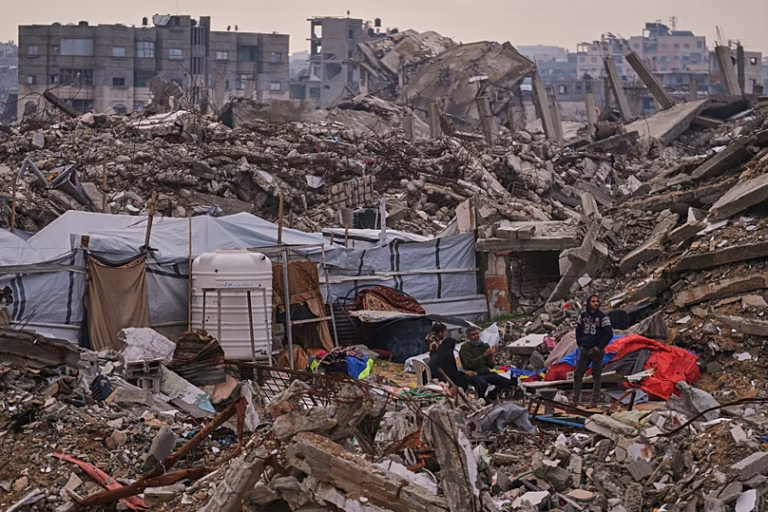
By framing Palestinians as subhuman threats, whose destruction is not only permissible but necessary, then no bomb is unjustified.

©AP Photo/Abdel Kareem Hana
Domestic media outlets reinforce this framing. For example, Channel 14, a pro-government broadcaster, has routinely blurred the line between civilians and fighters, reporting nearly all Palestinian deaths as “terrorists.” Critical coverage of the humanitarian catastrophe—famine, mass child deaths, the collapse of hospitals—is rare.
This creates a closed loop: leaders dehumanise Palestinians, the media amplifies it, and public opinion grows more hardline, which in turn emboldens leaders to escalate rhetoric and policy.

Genocide requires more than weapons; it requires a culture that accepts erasing the humanity of the victims. In Israel, decades of education, political rhetoric, and media bias have fostered just that. This genocide is not happening despite Israeli society—it is happening with its consent.
If dehumanisation made mass violence possible, only a radical rehumanisation—recognising Palestinians as equal in dignity and rights—can halt it. Until then, Gaza burns, and Israel’s public bears responsibility not only for what its leaders do, but for what it has been taught to believe.
©TNPP
Discover more from The New Palestine Post
Subscribe to get the latest posts sent to your email.